

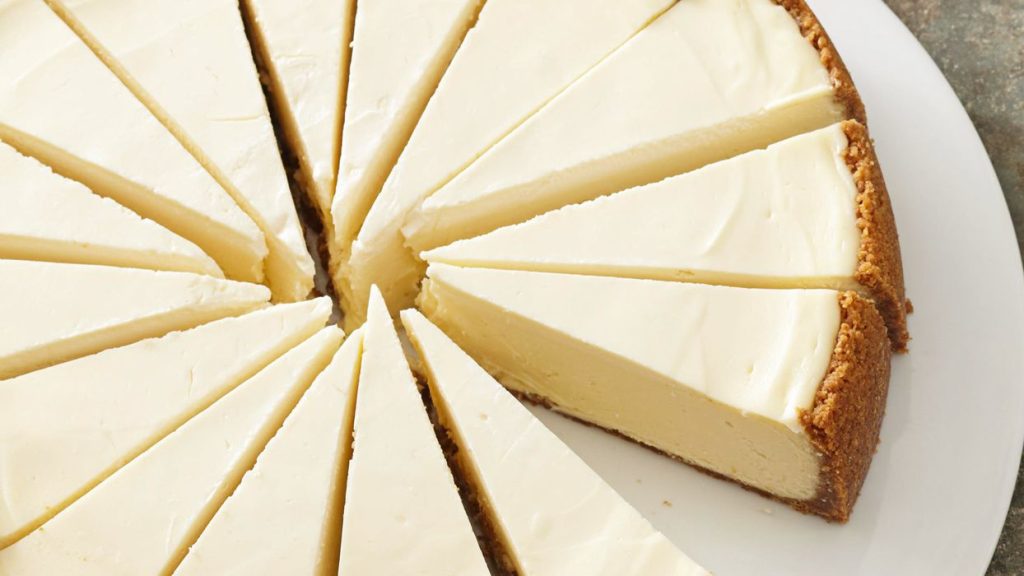
Classic New York cheesecake is known for its rich cream cheese flavor, dense yet creamy texture, and buttery graham cracker crust. Sour cream and heavy cream keep the filling smooth, while a small amount of flour gives each slice enough structure to hold its shape.
A water bath provides gentle, even heat and reduces the risk of cracks. The cheesecake then cools gradually before being refrigerated, which allows the center to finish setting without becoming dry.
Although the preparation is straightforward, this dessert requires several hours of cooling and chilling. Making it a day ahead gives the cheesecake plenty of time to develop the proper texture.
Why You’ll Love This Recipe
- Four packages of cream cheese create a rich New York-style texture.
- The graham cracker crust is crisp, buttery, and easy to prepare.
- Sour cream balances the richness with a subtle tang.
- A water bath promotes even baking and a smooth surface.
- The cheesecake can be prepared a day or two before serving.
- Individual slices can be frozen for later.
Ingredients
For the Graham Cracker Crust
- 2 cups graham cracker crumbs: Forms the crisp base of the cheesecake.
- 1/4 cup granulated sugar: Sweetens the crust and helps it hold together.
- 6 tablespoons unsalted butter, melted: Binds the crumbs and adds richness.
- Pinch of kosher salt: Balances the sweetness.
For the Cheesecake Filling
- 4 packages (8 ounces each) full-fat brick-style cream cheese, softened: Provides the cheesecake’s rich flavor and dense texture.
- 1 1/4 cups granulated sugar: Sweetens the filling.
- 3 tablespoons all-purpose flour: Adds structure and helps the cheesecake slice cleanly.
- 3/4 cup full-fat sour cream, at room temperature: Adds moisture and a mild tang.
- 1/2 cup heavy cream, at room temperature: Creates a smooth, creamy consistency.
- 1 tablespoon pure vanilla extract: Adds warmth and rounds out the cream cheese flavor.
- 1 tablespoon fresh lemon juice: Brightens the filling without making it strongly lemon-flavored.
- 4 large eggs, at room temperature: Set the cheesecake as it bakes.
- Hot water, as needed: Used for the water bath.
Ingredient Substitutions
- Graham cracker crumbs: Use finely crushed vanilla wafers or digestive biscuits.
- All-purpose flour: Substitute 2 tablespoons of cornstarch.
- Sour cream: Full-fat plain Greek yogurt can be used, although the flavor will be slightly different.
- Heavy cream: Heavy whipping cream can be used interchangeably.
- Unsalted butter: Use salted butter and omit the pinch of salt in the crust.
- Fresh lemon juice: It can be omitted or replaced with 1 teaspoon of finely grated lemon zest.
- Vanilla extract: Vanilla bean paste can be substituted in an equal amount.
Full-fat brick-style cream cheese is strongly recommended. Whipped cream cheese and spreadable cream cheese contain different amounts of air and moisture and may prevent the filling from setting properly.
How to Make New York Cheesecake
- Bring the ingredients to room temperature.
Set out the cream cheese, sour cream, heavy cream, and eggs before beginning. Room-temperature ingredients combine more smoothly and reduce the chance of lumps. - Prepare the pan and oven.
Preheat the oven to 350°F. Lightly grease the inside of a 9-inch springform pan. Wrap the outside of the pan in two large layers of heavy-duty aluminum foil, covering the bottom and sides to protect it from the water bath. - Make the crust mixture.
Combine the graham cracker crumbs, sugar, melted butter, and salt in a medium bowl. Stir until the crumbs are evenly moistened and resemble wet sand. - Press the crust into the pan.
Transfer the mixture to the springform pan. Press it firmly and evenly across the bottom using the base of a measuring cup or a flat-bottomed glass. - Bake the crust.
Bake for 10 minutes, until lightly fragrant and set around the edges. Place the pan on a wire rack and let the crust cool while preparing the filling. Reduce the oven temperature to 325°F. - Beat the cream cheese.
Place the softened cream cheese in a large mixing bowl. Beat with an electric mixer on low to medium-low speed for 2 to 3 minutes, scraping the bowl frequently, until completely smooth. - Add the sugar and flour.
Whisk the sugar and flour together in a small bowl. Gradually add the mixture to the cream cheese. Beat on low speed just until smooth, scraping the bottom and sides of the bowl. - Add the sour cream and heavy cream.
Mix in the sour cream, heavy cream, vanilla, and lemon juice on low speed. Stop once the filling is smooth and evenly combined. - Add the eggs.
Add the eggs one at a time, mixing on low only until each egg disappears into the batter. Scrape the bowl between additions. Avoid beating in excess air after the eggs have been added. - Fill the springform pan.
Pour the cheesecake filling over the cooled crust. Smooth the top with a spatula. Tap the pan gently on the counter two or three times to release large air bubbles. - Prepare the water bath.
Place the wrapped springform pan inside a large roasting pan. Transfer both pans to the oven. Carefully pour hot water into the roasting pan until it reaches approximately halfway up the sides of the springform pan. - Bake the cheesecake.
Bake at 325°F for 70 to 80 minutes. The outer 2 to 3 inches should look set, while the center should still have a gentle wobble when the pan is carefully moved. It should not look liquid. - Cool gradually in the oven.
Turn off the oven and prop the door open slightly with a wooden spoon. Leave the cheesecake inside for 1 hour. Gradual cooling helps prevent sudden contraction and cracking. - Cool at room temperature.
Carefully remove the cheesecake from the water bath and discard the foil. Place the pan on a wire rack and cool for another hour. - Chill the cheesecake.
Run a thin knife around the inside edge of the pan to loosen the cheesecake, but do not remove the springform ring yet. Cover and refrigerate for at least 6 hours, preferably overnight. - Release and slice.
Remove the springform ring. Cut the chilled cheesecake with a thin, sharp knife. Wipe the blade clean and warm it under hot water between slices for neat edges.
Tips for the Best Classic New York Cheesecake
- Use full-fat brick-style cream cheese for the correct texture.
- Bring all filling ingredients to room temperature before mixing.
- Scrape the bowl frequently so no cream cheese lumps remain.
- Keep the mixer on low after adding the eggs to avoid incorporating excess air.
- Wrap the springform pan carefully to keep water away from the crust.
- Do not bake until the center is completely firm. It will continue setting as it cools.
- Chill the cheesecake for at least 6 hours before slicing.
Common Mistakes to Avoid
Using Cold Cream Cheese
Cold cream cheese does not blend smoothly and can leave small lumps in the filling. Allow it to soften fully at room temperature.
Overmixing the Eggs
Too much air causes the cheesecake to rise excessively and then collapse or crack. Mix each egg only until incorporated.
Opening the Oven Repeatedly
Frequent temperature changes can interfere with even baking. Check the cheesecake near the end of the recommended baking window.
Baking Until the Center Is Firm
The center should still wobble gently when the oven is turned off. A completely firm center usually indicates that the cheesecake has overbaked.
Skipping the Chilling Time
Warm cheesecake will be too soft to slice properly. Refrigerate it for at least 6 hours, even if the center appears set.
Variations
Strawberry-Topped Cheesecake
Spoon cooled strawberry sauce over the chilled cheesecake shortly before serving. Fresh sliced strawberries can be added on top.
Blueberry Swirl Cheesecake
Drop spoonfuls of thick blueberry sauce over the filling before baking. Drag a thin knife through the sauce to create a swirl without mixing it completely into the batter.
Lemon New York Cheesecake
Add 1 tablespoon of finely grated lemon zest to the filling and increase the lemon juice to 2 tablespoons.
Chocolate Cheesecake
Melt and cool 8 ounces of semisweet chocolate. Mix it into the filling after adding the sour cream and heavy cream.
Sour Cream-Topped Cheesecake
Combine 1 cup sour cream with 2 tablespoons sugar and 1/2 teaspoon vanilla. Spread it over the baked cheesecake before the gradual cooling stage, then return it to the oven for 5 minutes.
What to Serve With Classic New York Cheesecake
- Fresh strawberries, raspberries, or blueberries
- Strawberry or blueberry sauce
- Cherry topping
- Chocolate ganache
- Caramel sauce
- Hot coffee or espresso
Keep toppings light so the cream cheese flavor remains the focus.
How to Store
Cover the cheesecake tightly or place individual slices in an airtight container. Refrigerate for up to 5 days. Keep strongly flavored foods covered so the cheesecake does not absorb refrigerator odors.
Cheesecake is usually served chilled, but individual slices can stand at room temperature for about 20 minutes before serving for a slightly softer texture.
To freeze, chill the cheesecake completely and place it uncovered in the freezer until firm. Wrap the whole cheesecake or individual slices tightly, then transfer them to a freezer-safe container. Freeze for up to 2 months.
Thaw frozen cheesecake overnight in the refrigerator. Avoid microwaving it, as uneven heating can damage the creamy texture.
Frequently Asked Questions
What makes New York cheesecake different?
New York-style cheesecake typically uses a generous amount of cream cheese and has a rich, dense texture. Sour cream or heavy cream may be added for smoothness and balance.
Is a water bath necessary?
The cheesecake can bake without one, but a water bath provides gentler heat and adds humidity to the oven. This helps the filling cook evenly and reduces the chance of cracks.
How do I prevent water from leaking into the crust?
Wrap the bottom and sides of the springform pan with at least two wide layers of heavy-duty foil. Make sure the foil reaches above the water level and contains no tears.
Why did my cheesecake crack?
Cracks can result from overmixing, overbaking, sudden temperature changes, or skipping the water bath. A cracked cheesecake is still suitable for serving and can be covered with fruit sauce.
How can I tell when the cheesecake is done?
The outer section should look set and slightly puffed. The center should move as one piece with a gentle wobble rather than appearing liquid.
Can I make cheesecake ahead of time?
Yes. Cheesecake is well suited to advance preparation because it needs several hours to chill. Make it one or two days before serving and keep it covered in the refrigerator.
Why is my cheesecake filling lumpy?
The cream cheese was probably too cold or was not beaten smooth before the other ingredients were added. Begin with fully softened cream cheese and scrape the bowl frequently.
Final Thoughts
Classic New York cheesecake requires patience more than complicated technique. Room-temperature ingredients, gentle mixing, a water bath, and gradual cooling produce a smooth filling that holds its shape after an overnight chill.